
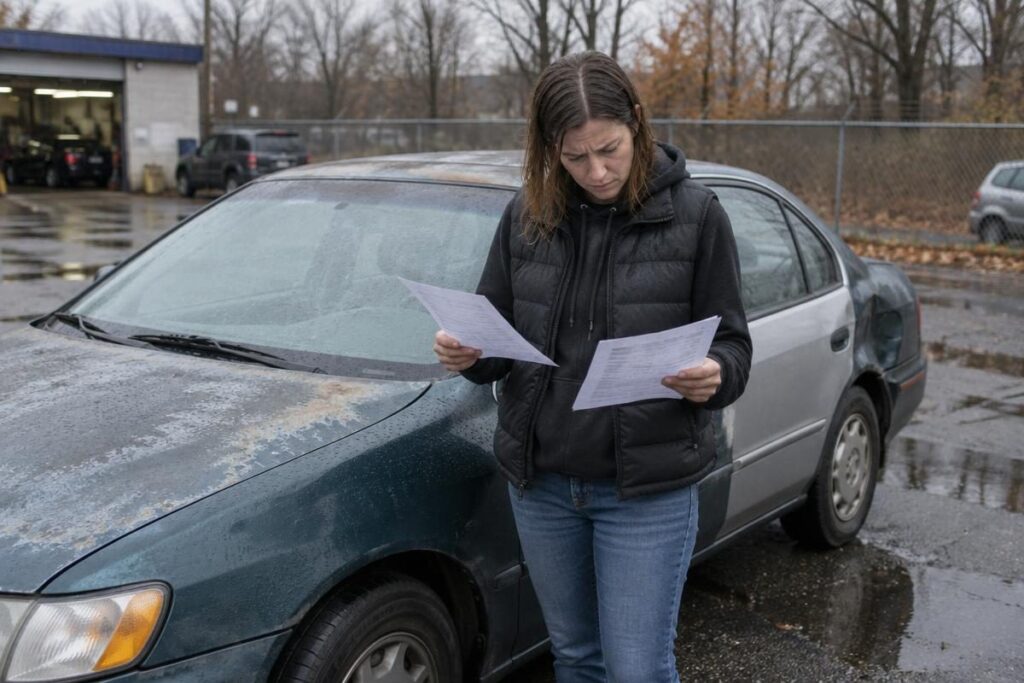
If you typed “car repair cost more than worth” into a search bar, you’re probably holding a shop quote in one hand and a price guide printout in the other, and the two numbers are uncomfortably close. The short answer: a repair that costs more than the car’s full value is usually a sign to stop, but one that costs nearly as much often isn’t, because the guide number assumes the engine already runs. Deciding whether to repair comes down to which number you compare against, whether the problem involves safety, and how long you’ll keep driving.
Enter the written quote and the private party value in the tool below for a verdict, a pass or fail on two common tests and a break-even month. Age, mileage and other work due this year sharpen the answer; the full version lives on the repair or replace car calculator page.
Repair or Replace Car Calculator
Enter the quote and what the vehicle is worth for a quick verdict. Add its age, mileage, the other work you expect this year, the payment on whatever you would buy instead and how long you plan to keep it, and the tool weighs several signals: the 50 percent of value rule, the one-year payment rule, the break-even month and the monthly cost of each path.
Your Verdict
Estimates only, not a quote and not financial advice. The verdict weighs common rules of thumb, the 50 percent of value rule and the one-year payment rule, which nobody can trace to a study; they are industry conventions repeated by Edmunds and Consumer Reports. Payment averages are Experian Q2 2026 figures. Safety problems, frame rust and reliability you no longer trust are not in the math and can outweigh it.
Which value should you compare the repair quote against?
Use private party value, then subtract the repair to see what the car brings as it sits. Most bad decisions start with the wrong number, and the three in play can sit hundreds of dollars apart:
| Number | Who pays it | When it is the right yardstick |
|---|---|---|
| Private party value | A buyer paying you directly | Any decision on a vehicle you own outright |
| Trade-in offer | A dealer, toward your next purchase | Only when you’re buying from that dealer this week |
| Actual cash value (ACV) | Your insurer, after a covered loss | Crash or theft damage with a claim open |
Kelley Blue Book (KBB) defines private party value as what a buyer can expect to pay a private seller, for a vehicle in working order. KBB says to deduct the cost of repairing broken equipment, and most owners overestimate condition. Dealer offers run lower because the dealer covers reconditioning, a safety inspection and overhead. Measure a quote against a dealer offer and nearly every fix looks like a bad deal.
A $3,000 quote on a $3,500 car, worked through
Enter a $3,000 quote against a $3,500 private party figure, leave everything else blank, and the calculator says close call. The quote is 86% of the $3,500, which fails the 50 percent test. It passes the one-year test, because $3,000 is less than 12 payments of $542 ($6,504), the Experian Q2 2026 average for a used vehicle loan. Skipping those payments pays back the repair by month 6.
Apply the KBB deduction and the $3,500 sedan with a $3,000 problem brings roughly $500 as it sits. Paying the shop doesn’t lose $3,000; it turns a $500 sedan back into a $3,500 one, buying back about as much resale as it costs.
A close call means two more details decide it. Say the example is 14 years old with 165,000 miles, and the shop also flagged $900 of brakes and tires for the coming year:
| Plan after the fix | Spend this year | Monthly cost to keep | Monthly cost to replace | Verdict |
|---|---|---|---|---|
| Quote and price only | $3,000 | Not shown | $542 | Close call |
| Keep it 24 months | $3,900 | $200 | $542 | Close call |
| Keep it 6 months | $3,900 | $575 | $542 | Replace it |
Same quote, opposite answers. Drive it two more years and keeping it runs $200 a month against a $542 installment, with break-even in month 7. Dump it in six months and you’ve paid more per month than a loan. The horizon matters more than the ratio.
Why the 50 percent test misleads on older cars
The 50 percent rule says that once a single repair costs half the market value or more, a replacement deserves a hard look. No traceable study backs it; Edmunds repeats it, and shop blogs repeat Edmunds. The one-year rule, credited to Edmunds and Consumer Reports, asks whether the quote is smaller than a year of payments on whatever you’d buy next.
On a cheap, older vehicle the two tests almost always split. Half of $3,500 is only $1,750, so a modest engine or transmission job trips the first, while few single jobs top $6,504 and fail the second. When they disagree, the one-year test describes your wallet and the half-value test your risk: a big repair bill on an aging vehicle is often the first of several.
Neither test cares what kind of work it is. Brakes, tires, steering, suspension joints and a rotted subframe are safety work: fix them or park it. Engine, transmission, cooling and charging problems are where the two tests earn their keep. A dented bumper or scuffed paint lowers the selling price but not the transportation, so cosmetic damage pays back only right before a sale.
Your options when car repair costs more than it’s worth
Six exits remain once the quote tops the as-is math. They pay very differently, so price at least two before signing anything.
Sell it as-is to a private buyer
A private sale usually nets the most. Ask the guide number minus the quote and hand over the written estimate; it shortens the haggling. Someone who does their own wrenching may pay more than your as-is number.
Trade it in at a dealership
A dealer pays less but takes one afternoon and absorbs the hassle. That’s the better deal when you’re buying there anyway and the offer sits close to your as-is number.
Donate it
Many charities will collect a vehicle that doesn’t run. The tax deduction usually follows what the charity actually sells it for, not the guide number, so read IRS Publication 4303 before counting on a write-off.
Junk or scrap it
Scrap is the floor, not the first call. Junkyards and salvage buyers pay mostly for metal weight and resellable parts, and they’ll want the title. Choose it only when the car won’t run or a private sale has failed.
Find a less expensive route
Before any exit, try to shrink the quote. Get a second written quote from an independent repair shop, ask about used, remanufactured or aftermarket parts instead of OEM, and check the hourly rate against typical auto repair labor rates. For dents and panels, paying for body repair without insurance covers the budget routes.
Then run the VIN through NHTSA’s recall lookup. Federal law (49 U.S.C. 30120) makes the manufacturer remedy a safety defect without charge, but that duty ends for vehicles first sold more than 15 calendar years before the recall notice. On an older vehicle, check before you assume it’s covered.
Fix it anyway when the numbers still work
Paying more than the car would fetch can still be the right choice when it’s paid off, you know its history, nothing else big is due, and you’ll keep it well past break-even. If cash is the problem, the car repair loan calculator shows what financing the fix adds each month.
Why repair costs rise as the car ages
Upkeep climbs with age while resale falls. CarEdge data puts a Toyota Camry at $207 of maintenance and repairs in year one and $670 in year ten, and a Ford Edge at $397 rising to $1,433. The Bureau of Labor Statistics measured motor vehicle maintenance and repair prices up 5.2% in the 12 months to August 2026, while used car and truck prices fell 2.3%. Car repair costs are climbing while the asset shrinks.
Newer tech adds its own bill. A camera or radar sensor in the bumper turns a parking-lot tap into an expensive job: AAA found in 2018 that a minor front or rear collision on a vehicle with driver assistance systems could cost as much as $5,300 to repair. Those sensors also prevent crashes through automatic emergency braking, so disabling them to save money is a poor swap.
None of this dooms an old vehicle. S&P Global Mobility put the typical age of cars and light trucks in use at 12.8 years for 2025, and Consumer Reports found a well maintained one can reach 200,000 miles. To weigh several years of repairs, fuel and payments, use the keep an old car or buy another comparison.
After an accident, the insurer decides first
With a claim open, the insurer’s ACV becomes the number that matters. Thirty jurisdictions set a total loss threshold in law, and 21 states use the total loss formula. The $3,000 on $3,500 example is 86%, well past Iowa’s 70% line, and insurers can total a vehicle below their state’s threshold anyway. If the claim pays out, the check settles the repair decision. See totaled or repaired for the state-by-state thresholds and what a buyback costs.
Start with a written estimate and a second opinion (the guide on how to get a repair estimate covers what it should list), then look up the private party value for your exact trim and mileage and subtract the quote. Run both numbers through the tool above and decide how long you’ll realistically keep it. If your own “car repair cost more than worth” check points to selling, price a private sale and a dealer offer before you call a junkyard.
Questions drivers ask before paying the shop
What if repair costs exceed the value of my car?
Selling is usually smarter. Once the quote reaches the private party figure, the calculator counts it as a double strike. Keep the vehicle only if the repair is cheaper than a year of replacement payments and you’ll drive it long enough to reach break-even.
What is the $3000 rule for car repairs?
It’s a personal finance blog heuristic: treat any single job over $3,000 as a cue to price a replacement. It ignores what the vehicle sells for, so it’s a blunt tool. $3,000 on a $15,000 SUV is routine; on a $3,500 sedan it eats 86% of the resale.
At what point is car repair not worth it?
When the quote tops the market value, when the vehicle is unsafe and you won’t pay for safety work, or when you’ll sell it before break-even. In the example above, keeping it six months instead of 24 flipped the verdict from close call to replace.
Estimates only, not a quote. This guide is general information, not financial or tax advice; the half-value and one-year tests are habits of the trade rather than law, and the replacement payment figures come from Experian for the second quarter of 2026. Last reviewed: October 2026.