
Auto body repair without insurance makes sense more often than drivers assume. The usual advice, file whenever the damage beats your deductible, skips the expense that shows up later. In ValuePenguin’s July 2026 sample, one at-fault accident raised full coverage premiums by $102 a month, or 49 percent, and that surcharge usually lasts three to four years. So the real test is short: pay cash when the estimate is smaller than your deductible plus the total extra premium.
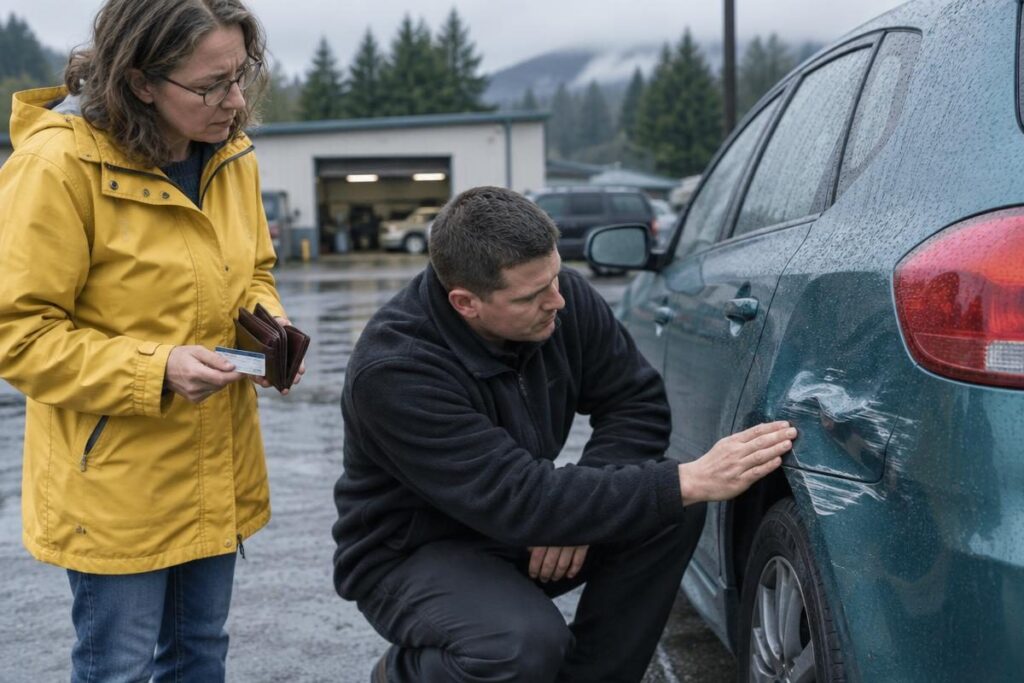
Cash or claim: the break-even is your deductible plus the surcharge
The break-even repair cost is the bill at which filing and paying cash come out even: your collision deductible plus every month of higher premium the claim triggers. Below that line, a claim loses money even though the insurer writes a check.
- Get a written cash price. Ask for an itemized body shop repair estimate, parts and labor hours on separate lines, so you can compare it with other shops. See how to get a car repair estimate.
- Find your deductible on the declarations page of your auto insurance policy.
- Price the surcharge. Multiply your current premium by 34 to 49 percent (the at-fault averages from Insurify and ValuePenguin), then by three years.
- Add the two. If the estimate is lower, pay out of pocket. If it’s higher, the claim probably earns its keep.
The record outlives the price hit. A CLUE report, the claims history insurance companies pull when you shop, holds auto claims for seven years, per the Texas Department of Insurance.
How far premiums rise after an at-fault accident, state by state
Insurers differ more than the averages suggest: for the same driver, ValuePenguin saw State Farm add 14 percent and Geico 73 percent. Insurify’s September 2026 at-fault average is near 34 percent. Four states set firm limits:
- California: under regulation 10 CCR 2632.13, a driver is principally at fault only when at least 51 percent responsible and the crash caused an injury or more than $1,000 of total property damage. Lawfully parked or rear-ended drivers are presumed not at fault.
- Oklahoma: section 941 of the insurance code bars a carrier from raising a liability or collision rate because you were in a collision that wasn’t your fault, per the Oklahoma Insurance Department.
- North Carolina: the Safe Driver Incentive Plan charges 1 point, a 40 percent surcharge, for an at-fault crash with $2,300 or less of property damage, with a no-points exception for clean households, per the NC Department of Insurance. Articles quoting a $3,570 line cite HB 53, which stalled in a Senate committee in April 2025 and never became law.
- Massachusetts: an at-fault claim becomes surchargeable once the insurer pays more than $1,000 beyond the deductible ($1,000 to $5,000 is minor, over $5,000 major), and the surcharge stays for six years.
Worked example: a $1,125 bumper cover against a $500 deductible
You back a midsize sedan into a post and crack the front cover. This site’s bumper calculator prices a new aftermarket cover, painted, at an independent repair shop at $1,125 with no parking sensors. The collision deductible is $500, so a claim would pay $625.
| Route | Paid now | Extra premium, 3 years | Total |
|---|---|---|---|
| Pay cash | $1,125 | $0 | $1,125 |
| Claim, average surcharge ($102 a month) | $500 | $3,672 | $4,172 |
| Claim, smaller surcharge (about $27 a month) | $500 | $964 | $1,464 |
At the average surcharge, the claim costs $3,047 more than cash. The smaller row, for the same repair, uses State Farm’s 14 percent (roughly $27 a month on that sample policy), and cash still wins by $339. Three years is the short end of the usual surcharge period, so the real gap is often wider. The $4,172 break-even matters for bigger hits: CCC’s Crash Course 2026 put the average repairable claim at $4,818 for 2025, just above the line, so damage on that scale usually belongs on the policy.
How much is car repair without insurance for common body damage?
Prices below come from this site’s calculators, run as cash body work: midsize sedan, independent shop, $85 an hour body labor (NABR, August 2026), $48 paint and materials per paint hour.
| Damage | Typical cash price | Cheaper option |
|---|---|---|
| 3 inch ding on a door, paint intact | $970 fill and refinish | $395 paintless |
| Cracked bumper cover | $1,125 new cover | $785 repaired |
| Caved-in rear door | $1,775 new shell, painted | $680 used, same color |
| One metallic door repainted | $775 with blend | None |
| Sideswipe across three panels | $2,495 | None |
| Windshield chip | $60 to $100 | None |
Run your own panel count in the body repair cost calculator, or size a single ding with the dent repair calculator.
Five ways to cut a cash body shop repair bill
- Paintless dent repair (PDR) is a technique that massages metal back from behind the panel, leaving the factory finish alone. With paint intact it costs well under half the conventional fix.
- CAPA certified parts. The Certified Automotive Parts Association is a nonprofit that has certified more than 128 million aftermarket crash parts since 1990, testing samples in independent labs. Its standards cover fenders, hoods and front fascias.
- Recycled parts. A complete door runs $75 to $150 at a self-service yard against $700 to $1,400 new from the automaker. A same-color door can skip paint entirely, which is how the $680 door above happens.
- Fix safety and function first. Lights, latches, anything rubbing a tire and sensors on cars equipped with advanced driver-assistance systems come before cosmetic body panels, on a new car or an old one. A front radar for lane departure warning or emergency braking alone runs $500 to $1,300 (AAA). The bumper cost calculator separates that line.
- Negotiate line by line. Ask whether each panel can be repaired instead of replaced, whether blending is needed, and how the labor compares with published repair times. Two or three written quotes give you leverage. If the total stretches your budget, ask about flexible payment options and compare the interest with the car repair loan calculator.
Ask for a teardown before agreeing on a final cash number. Hidden structural damage behind a cover only shows once trim is off.
Glass, hail and the other driver’s fault: when filing costs little
Some claims don’t carry the at-fault price tag. When another driver hits you, their property damage liability pays and your deductible doesn’t apply. Glass is the other exception. Florida’s statute waives the comprehensive deductible on the windshield, Kentucky waives it for glass-only claims including camera recalibration, and South Carolina waives it for all automobile safety glass. Weather damage like hail falls under comprehensive coverage, but every claim still lands on your seven-year record.
When to file a collision claim even though you could pay
- Anyone was hurt. Medical bills can dwarf any repair bill, and the standard personal auto policy requires prompt notice of how, when and where an accident happened.
- The other party might come back later. Paying your own repair in cash doesn’t settle what they could claim against you, so report the crash to your insurer even if you never file for your car.
- The estimate passes your break-even. Frame pulls and multi-panel hits climb fast; the sideswipe above is already $2,495 before any structural work. Near the car’s value, check whether it’s totaled or repairable.
Before you call your insurer, get one itemized estimate. Then find your deductible and add three years of likely surcharge. If the estimate is smaller, auto body repair without insurance is the cheaper route: take the estimate to a second shop, ask about paintless, CAPA or recycled options, and fix the safety items first.
Frequently asked questions about auto body repair without insurance
Can I get my car repaired without insurance?
Yes. Collision repair shops sell collision services to cash customers every day; you sign the estimate and pay on pickup instead of direct insurance billing, where the shop would bill the carrier directly. You also pick the parts, so recycled or CAPA parts are easier to request.
How do insurance deductibles and out-of-pocket payments work?
On a claim, you pay the shop the deductible and the insurer pays the rest. Without a claim, you pay the whole bill. The gap between them is what the insurer covers, and that’s the figure to compare with the surcharge.
Is it better to get a quote from an insurance company or an auto body shop for damage?
Start with the shop. A collision center can review the damage and write a repair estimate without opening a claim file, and that cash price is the number you need for the break-even test.
How much does insurance go up after a not-at-fault accident?
Insurify’s September 2026 data shows about 22 percent on average, though California and Oklahoma bar insurers from raising rates for a crash you didn’t cause.
Do auto body shops offer payment plans for repairs?
Some do, usually through a third-party lender. Compare the APR and total repaid, not just the monthly payment. On deferred-interest offers, any balance left when the promotion ends can bring back interest from the purchase date, a trap the Consumer Financial Protection Bureau warns about.
Estimates only, not a quote. Premium figures are published averages for sample drivers; your insurer’s surcharge may differ. State rules are summarized, not legal advice. Last reviewed: November 2026.