
How much to repair car brakes comes down to which job and how many axles. Shops quote this work per axle, meaning both front wheels or both rear wheels, because friction parts are always fitted in matched pairs. At the $132 national shop rate, new pads on one axle of a midsize sedan cost about $320 to $330, adding rotors brings it to $435 to $530, and a full job on all four wheels runs about $865 to $1,060 before tax.
Choose the repair written on your estimate, then front or rear axle or all four wheels, your vehicle type, the kind of shop and your state. You get the price for the wheels you picked, the cost for one axle, the full four-wheel job for comparison, and what the same parts cost over a parts counter. Parts and labor are split out so you can check a quote line by line.
Brake Repair Cost Calculator
Pick the job the shop quoted, which axle, your vehicle type and where you will have it done. The estimate shows parts, book hours at your state's labor rate and shop supplies, the price for one axle, a full pads and rotors job on all four wheels, and what the parts cost if you do it yourself.
Your Estimate
Estimates only, not a quote. Based on September 2026 RepairPal shop estimates for a midsize sedan, published book hours, retail parts bands and your state's posted labor rate. Rear drum brakes, seized hardware and rusted steel lines are not modeled. Sales tax is not included.
How Much to Repair Car Brakes, Job by Job
These average brake repair prices are typical 2026 figures at an independent shop for a midsize sedan at the $132 US average rate, before tax. The calculator re-prices every row for your state, shop and vehicle.
| Job | Scope | Book hours | Low | Typical | High |
|---|---|---|---|---|---|
| Pads only | One axle | 1.0 | $320 | $325 | $330 |
| Pads and rotors | One axle | 1.38 | $435 | $480 | $530 |
| Calipers (pair) with bleed | One axle | 2.4 | $595 | $835 | $1,080 |
| Rubber hoses (pair) with bleed | One axle | 1.8 | $360 | $415 | $475 |
| Master cylinder | Whole car | 1.82 | $680 | $705 | $730 |
| Fluid flush | Whole car | flat price | $160 | $195 | $230 |
| Full job: pads and rotors | All four wheels | 2.76 | $865 | $965 | $1,060 |
So how much do brakes cost in practice? The cost of brake replacement runs above the “$150 per axle” you’ll see in older guides. AAA puts a pad job at $150 to $350 per axle and Kelley Blue Book says around $150, but neither page is dated. RepairPal’s Camry estimate, updated September 3, 2026, runs $304 to $368 for the same axle, and a YourMechanic front quote on a 2016 Camry came to $316. The cheap number is real; it just assumes economy linings and a low labor rate.
Replacement costs climb with the vehicle. Parts for European-made vehicles and luxury models run about 60 percent higher, and a heavy SUV or truck carries bigger friction parts than a compact. Prices also shift depending on where you go, since a dealer service center adds higher labor costs to the same brake service. Your make and model and your choice of shop move the result more than anything else; the labor rates by state page shows how far the hourly figure swings.
How Much to Repair Car Brakes in Texas: A Worked Example
Take a midsize sedan at an independent shop in Texas, where the posted rate is $124 an hour. The front pads are worn and both discs are under spec.
- Labor: 1.38 hours x $124 = $171.
- Parts: one pad set plus two discs, $242 to $339, typical $291.
- Shop supplies: 5 percent of labor, $9.
- Total: about $470, with a range of $420 to $520.
The same job at a Texas dealer comes to about $590, because the dealer’s labor and parts both carry a 25 percent premium. Doing the rear axle at the same visit roughly doubles it: $940 for all four wheels at the independent shop. If you bought new pads and new rotors yourself, they’d run about $200.
What Goes Into a Per-Axle Brake Quote
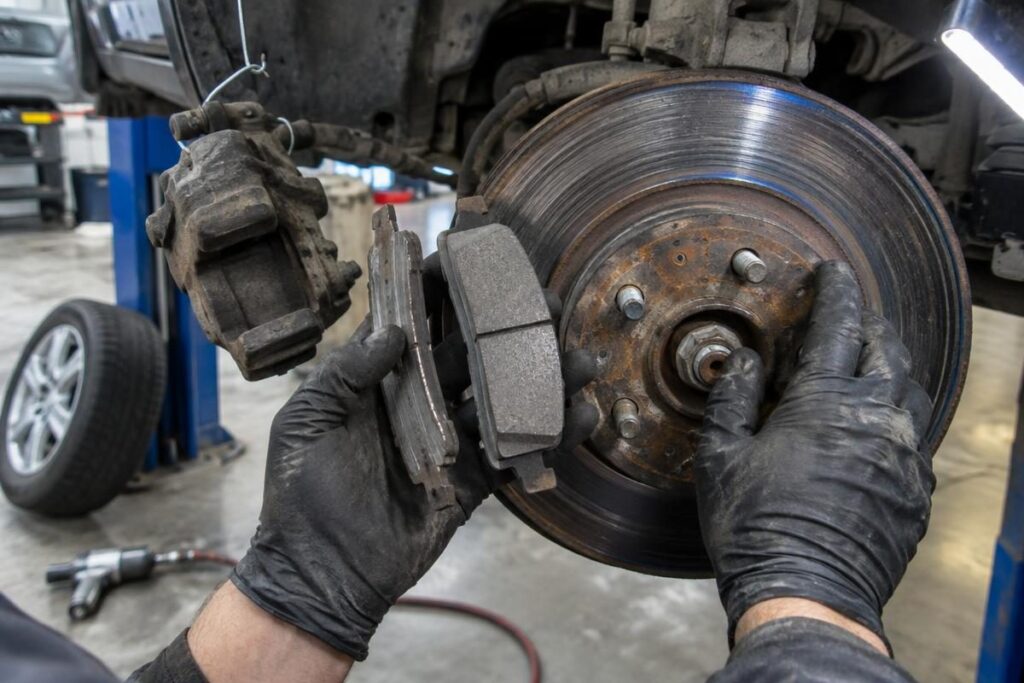
A brake job is the replacement of worn friction parts (pads, and often the rotors they clamp) on one or both axles, sometimes with hydraulic work added. RepairPal’s estimate pages say these parts are done in pairs, side to side, because uneven grip can make the car pull under braking.
The bill itself has three lines. Parts, at the shop’s list price. Labor, which is book time (a published hour figure for the job) multiplied by the posted rate. Then a small supplies charge. Hydraulic jobs may require more time, depending on the vehicle. On a Toyota Camry, RepairPal’s September 2026 figures work out to 1.0 book hour for a pad replacement on one axle and 1.38 hours when the discs come off too. Those hours barely move from shop to shop; the hourly rate is what does, which is why the same brake repair costs more in California than in Mississippi. Our book time guide explains how those hours are set. Some economy cars still run drum brakes on the rear axle (shoes pressing outward against a drum), which the calculator does not price separately.
Pads Only, or Pads and Rotors?
A rotor is the iron disc the caliper squeezes. It needs replacing when it’s too thin to shed heat safely or too uneven to stop smoothly, and the part itself tells you which. The minimum (“discard”) thickness is stamped into the disc, so a mechanic with a micrometer can give you a yes or no instead of an opinion. We tell drivers to ask for that micrometer reading, written next to the stamped figure, before they approve new discs.
- Measure against the stamp. A disc at or under the discard figure is done. To be resurfaced it has to sit at least 0.015 inch above that number, enough to survive the cut and the life of the new linings.
- Feel the brake pedal. Pulsing under steady stops is thickness variation in the disc, which MOTOR’s technical writers list as the cause of pedal pulsation. “Warped” is the common word for it.
- Check the grooves and the edge. Grooves around 0.060 inch deep mean resurface or replace, and a thick rust lip from corrosion on the outer edge usually goes with a thin, pitted face.
- Listen for a grind. Metal-on-metal grinding means the lining is gone and the backing plate is cutting the disc. Once rotors are worn that far, they need replacement instead of a cut.
Why do most shops now quote new rotors rather than machining the old ones? MOTOR notes that lighter braking systems use discs that start out thinner, with little metal left to cut. And a lathe takes about 30 minutes per disc, so a pair is roughly one hour, or $132 at the national rate, while a new pair costs $60 to $150 retail. Replacing rotors is the default now, not an upsell, unless yours measure thick and smooth.
Warning Signs and the Repair Each One Points To
Each symptom points at a different part, and the part sets the price. A high squeal on light stops is usually the wear indicator, a steel tab that touches the disc when the lining gets thin, so a pad-only job may still do. The hydraulic side of the brake system costs more because every job there ends with bleeding air out of the lines:
- Pulling to one side, a hot wheel, a burning smell, or one side wearing far faster: a sticking caliper. RepairPal prices one on a Camry at $521 to $589 installed and recommends doing them in pairs.
- Wet residue near a wheel or a swollen rubber line: a leaking hose, about $210 for one, $415 for the pair on an axle.
- A pedal that slowly sinks to the floor with no visible leak: often the brake master cylinder, the pump under the hood that feeds every wheel, about $705 installed.
Can you drive on bad brakes? Not when the brakes feel soft, the pedal sinks, the car pulls hard, or fluid is leaking. A leak is a park-it problem, because it can cut braking performance or take it away entirely. A sticking caliper left alone tends to lead to expensive repairs, since it wears out the pad and rotor on that corner. The leak repair cost calculator prices the leak itself.
Brake fluid absorbs moisture over time. YourMechanic and Honda both put the change interval near three years, or 24,000 miles in YourMechanic’s case. YourMechanic’s average flush is $158, with model-year quotes up to about $232. Routine brake maintenance like this, plus a brake inspection at every tire rotation, is what keeps a $325 job from turning into an $835 one.
What a $99 Brake Special Usually Covers
A $99 special is almost always economy pads on one axle with the labor to fit them, well under the $320 to $330 typical job in the table. The reason the advertised number rarely survives the visit is that it assumes your discs pass, your clips and hardware are reusable, and your fluid is clean. On a car at its first pad change, one of those often fails, and rotors, hardware, a better compound, a flush and the second axle all bill extra.
Brake pad material is the line to ask about. AAA describes semi-metallic compounds as having excellent stopping power and heat resistance, while ceramic pads cost more but last longer in daily driving. Ceramic sets run about $50 to $100 at retail. For towing or using the brakes to control downhill speeds, semi-metallic suits the heat; for a commuter, ceramic usually wins on dust and noise. Towing and long grades shorten the lifespan of any compound, so check brake pad wear at least once a year.
Many newer cars have an electronic parking brake, a motor built into each rear caliper. A technician needs a scan tool to put it into service mode before the pistons can be pushed back, and forcing it can set fault codes or damage the unit, as Tomorrow’s Technician warns. Rear work on these cars isn’t a $99 job or a casual driveway one.
DIY Brake Pad Replacement: Parts Against the Shop Bill
Retail parts for a front axle are modest. AutoZone and Direct Brakes list the same bands: pads $35 to $150 per axle set, rotors $30 to $75 each, and remanufactured calipers up to about $130 each. Replacing brake pads and rotors on one axle comes to roughly $95 to $300 in parts, about $200 typical, against $480 at an auto repair shop.
The gap is real money, but you need a torque wrench for the lug nuts (uneven torque is one cause of disc thickness variation), a way to bleed the system for any hose or hydraulic work, and a scan tool for an electric rear unit. The calculator shows DIY prices for pads, discs and remanufactured units only; hoses and master cylinders aren’t priced for home work.
When a Brake Bill Should Make You Rethink the Car
Routine friction work almost never decides whether to keep your car. A $965 four-wheel job is normal wear on a car worth $8,000. The math changes on an old car with several problems at once: a complete brake repair with new hydraulics on both axles, hoses and a new pump under the hood can pass $2,000, and if that tops half the vehicle’s value, run the repair or replace calculator before you sign. For a sense of what’s fair across other jobs, see how much car repairs should cost.
Before you approve brake repair services, ask the shop for the rotor thickness readings, the pad compound, and the book hours per axle in writing. Run those through the calculator above to see how much to repair car brakes should cost in your state, and if the quote runs more than 20 percent over the high end, get a second one using our guide to getting a repair estimate. If a bad brake symptom shows up, such as a soft pedal or a pull, get your brakes replaced or inspected now rather than at the next oil change. Our car repair cost calculator covers any other repair on the same visit.
Questions About Brake Repair Costs
How much should a full brake job cost?
Pads and rotors on all four wheels of a midsize sedan cost about $865 to $1,060 at an independent shop at the $132 US average rate, typical $965. Dealers, luxury models and high-rate states push it higher; add calipers and it can double.
Do I need to replace rotors with brake pads?
Not always. If the discs measure above the minimum thickness stamped on them, with no pulsation and no deep grooves, new linings alone are fine. Most shops replace them anyway because a new pair often costs less than the labor to machine the old ones.
Is it safe to drive with grinding brakes?
No. Grinding usually means the lining is gone and steel is scraping the disc, which weakens stopping and destroys the rotor. On one axle that moves the bill from about $325 to about $480.
How long does a brake job take?
Book time is about 1 hour per axle for pads and about 1.4 hours with rotors, so a four-wheel job bills under 3 hours. Hydraulic work or a full bleed adds more.
How long do brake pads last?
AAA gives 30,000 to 80,000 miles, and Kelley Blue Book puts the average near 40,000. Stop-and-go driving, towing and the compound all shorten or extend that.
How often should I have my brakes inspected?
At every tire rotation, and at least once a year. With the wheels already off, a mechanic can measure lining and disc thickness in a few minutes, which catches a $325 job before it becomes a $480 one.
Estimates only, not a quote. Figures come from RepairPal shop estimates dated September 2026, retail parts listings and state labor rates; your vehicle and shop will differ. Last reviewed: November 2026.