
Engine repair and replacement cost runs from about $550 for a misfire cured with new plugs and a coil to $14,000 or more for a new long block in a diesel pickup. Most bills fall in between, and the gap between fixing one part and swapping the whole engine is often smaller than owners expect. A head gasket on a four cylinder sedan prices at $2,895 typical; a used long block installed in the same car comes to $3,575. The calculator below lines up all five choices for your problem, engine type and state.
Pick the problem, the engine type and the fix you’re leaning toward. The headline shows that fix; underneath sit the in-car repair, a rebuild and three installed long blocks, each with labor hours at your state’s posted shop rate. Add the private party value to see what share of the vehicle the bill eats.
Pick the problem, the motor type and the fix you are leaning toward. You get an in-car repair, a rebuild, and used, remanufactured and new long block swaps side by side, each with its labor hours at your state's shop rate.
Your Options
Estimates only, not a quote. Built from 2026 US shop labor rates by state, published book and automaker labor times, and long block price bands from consumer pricing guides and factory parts lists. Prices for your exact motor, its availability and the shop's own rate will move the figure. Sales tax is not included.
Average cost to fix an engine problem without swapping it
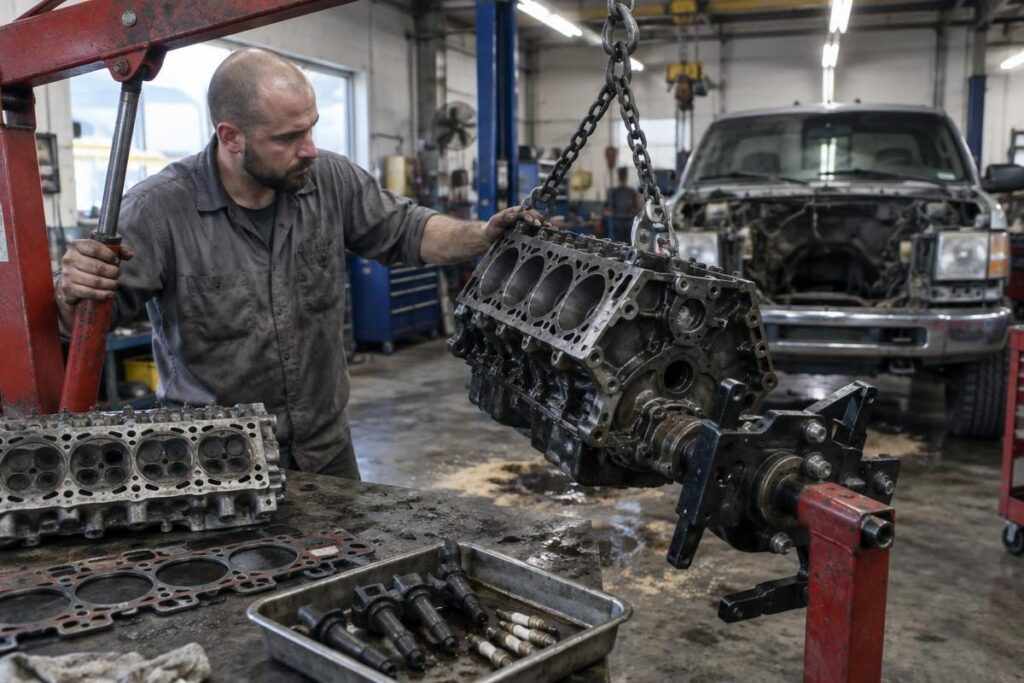
A long block is the assembled block and cylinder heads with the crankshaft, pistons, camshafts and valves already inside, minus the intake, exhaust, sensors and accessories. Four of the seven problems in the tool can be fixed without pulling it. These prices assume a midsize vehicle, an independent shop at the $132 national average hourly rate and a confirmed diagnosis.
| Problem | In-car fix | Book hours | Typical (low to high) |
|---|---|---|---|
| Blown head gasket, or damage after an overheat | Gasket replacement | 13.7 to 16.5 | $2,895 ($2,635 to $3,150) |
| Stretched timing chain | Chain, guides and tensioner | 10.9 | $2,270 ($2,260 to $2,280) |
| Timing belt due | Belt and tensioner | 4.04 to 4.94 | $1,005 ($875 to $1,140) |
| Misfire | Spark plugs plus one ignition coil | 1.45 to 2.12 | $550 ($470 to $635) |
| Rod knock | None; a bearing noise that rises with revs needs a rebuild or another block | n/a | See the swap table |
| Burning oil | None once the piston rings are worn | n/a | See the swap table |
That first row matches the leak repair calculator, since vanishing coolant is often the first clue. V6, V8 and most diesel engines have two heads, so expect quotes near the top or past it. A snapped timing belt on an interference engine lets the valves hit the pistons, which turns the job into valve work or a swap. A cracked head or block, common after a hard overheat, sends you straight to the swap table.
Engine replacement cost by motor type: used, reman and new side by side
An engine replacement means pulling the old long block and installing another, then moving the intake, exhaust, sensors and accessories across. Two things set the cost estimate, and they move independently: the block itself and the book hours to swap it. Both climb with cylinder count.
| Motor | Swap hours, typical (range) | Rebuild | Used, 60k to 120k miles | Remanufactured | New OEM |
|---|---|---|---|---|---|
| 4 cylinder | 10.8 (6.5 to 15) | $3,955 | $3,575 | $7,225 | $7,935 |
| V6 | 14.9 (9.8 to 20) | $4,425 | $4,665 | $9,665 | $10,640 |
| Turbocharged gas | 16.8 (13.6 to 20) | $4,425 | $4,915 | $9,915 | $10,890 |
| V8 | 21.8 (18.6 to 25) | $5,135 | $6,115 | $12,465 | $13,705 |
| Diesel | 25.6 | $5,635 | $6,615 | $12,965 | $14,205 |
Each figure is a typical installed total at the national rate with shop supplies; the swap columns also carry a changeover kit (water pump, spark plugs, oil and filter). Mileage moves the used column most: a four cylinder reads $3,090 over 120,000 miles and $4,060 under 60,000. A pickup, SUV or luxury vehicle pays more for parts, and a dealership adds about a quarter to parts and labor.
Worked example: engine repair and replacement cost on a $6,000 sedan
Take a four cylinder midsize car worth $6,000 once it runs right, with a head gasket failure a shop has confirmed, priced at an independent shop at the national rate:
- Repair in the car: $2,895 typical, 48 percent of the car’s value.
- Used long block, 60,000 to 120,000 miles: $3,575, with 10.8 hours of swap labor.
- Rebuild the original engine: $3,955.
- Remanufactured: $7,225. New OEM: $7,935. Both cost more than the car is worth.
The used block costs $680 more than the gasket job and replaces every worn part inside, but it arrives with an unknown history and a parts-only warranty. The gasket job keeps an engine you know, provided the block test passes and the head isn’t warped. At 48 percent this sits under the half-of-value line, so the in-car repair is the stronger bet if the transmission and body are sound. To test the rest of the math, enter $2,895 as the quoted cost of the fix in the repair or replace car calculator.
Installation labor: where the swap hours come from
Book time is the published labor allowance a shop bills for a job, whatever the clock says. For swaps, the most trustworthy numbers come from the automakers themselves, printed in recall and service bulletins filed with NHTSA:
- Hyundai pays 4.8 to 6.5 hours to replace a 2.4 or 2.0 liter four cylinder (TSB 26-01-033H, March 2026).
- Hyundai pays 9.5 hours front wheel drive and 9.8 all wheel drive for the 2024 Palisade’s V6, alignment included.
- Toyota pays 13.6 hours to swap the twin-turbo V6 in a 2022 Tundra (Safety Recall 24TA07).
- GM’s labor guide gives 18.5 to 18.6 hours for the 6.2 liter V8 in a Chevy Silverado, plus 1.2 hours to recover and recharge R-1234yf air conditioning.
Those are warranty times, which usually run shorter than the standard time an independent shop bills (the guide to flat rate book time explains why). The calculator uses them as each range’s floor and published retail ranges as the ceiling: 15 hours for a four, 20 for a V6 or turbo, 25 for a V8, and 25.6 for a 2007 F-350 diesel per one labor guide. Rust or a seized bolt pushes a job toward the top.
Used engine mileage, warranty and the parts you must replace
A used engine is the cheapest swap and the riskiest one. LKQ, a national auto parts recycler, warranties its recycled units for 6 months or 6,000 miles, whichever comes first. That covers the part only, not the labor to swap it again, and it doesn’t transfer to the next owner.
Its installation checklist also requires the installer to do this work, or the warranty can be void:
- Find and fix why the original engine failed. A cooling fault that killed the first block will kill the second.
- Replace the timing belt, water pump, thermostat, spark plugs, hoses and drive belts.
- Inspect and replace the front and rear main seals plus the valve cover and oil pan gaskets.
- Move the flywheel, oil pan, mounts and manifolds over from the old block.
- Replace the oil cooler, or the radiator when the cooler is built into it.
That’s why every swap column carries a $505 to $817 changeover kit. Engine mount replacement costs are separate; the old mounts move across unless cracked, and the recycler doesn’t cover them. Ask for the donor vehicle’s VIN and mileage, and confirm it’s compatible: the same engine code and, on four wheel drive models, matching gear ratios. Keep receipts too, since LKQ voids the cover unless oil changes are documented every 4,000 miles; regular maintenance is part of the deal.
Rebuild, remanufactured or new OEM: what the extra money buys
An engine rebuild means a local shop handles the disassembly of your own motor, machines what’s worn back to specification and reassembles it with new bearings, rings and gaskets. Kelley Blue Book puts a rebuilt engine at $3,500 to $6,000, with 12 months or 12,000 miles a common shop warranty. A remanufactured long block is rebuilt in a factory to original tolerances. KBB quotes $5,000 to $9,000 before installation, and JASPER, a large remanufacturer, backs its gas units for 3 years or 100,000 miles, parts and labor, nationwide and transferable.
New isn’t always the top price for an OEM engine. GM’s own parts catalog lists a new engine assembly for the 3.6 liter V6 at $6,488.90 and the remanufactured one at $7,508.67; its 2.5 liter four lists at $4,382.78 new and $7,249.90 remanufactured. Ask the shop to quote both part numbers before assuming reman is the budget pick, and ask whether the vehicle manufacturer’s parts warranty covers labor at an outside shop.
Rebuilding an engine makes sense when the block and crankshaft are healthy and a good machine shop is nearby. Go reman when you’ll keep the car for years. A used engine fits a car you’ll sell within a year or two.
Engine condition, inspection and when to walk away from the car
Before deciding the engine needs replacing, pay for an inspection: a compression or leak-down test, a block test for combustion gas in the coolant, and a look at the oil for metal or contamination. A misfire that survives new plugs and a coil, or white smoke that returns after the repair, means the trouble is deeper than the quote.
Then look at the rest of the vehicle. A $7,225 remanufactured engine in a $6,000 car still leaves a $6,000 vehicle with the same tired transmission, which the transmission repair and replacement cost calculator prices on its own. Reliability improves where the work was done, nowhere else, and when the engine and transmission both show their age, that money usually does more toward another vehicle. If the bill passes half the car’s value, read is my car worth fixing before you compare it with a new car payment.
Start with a confirmed diagnosis, then run your problem through the calculator with your state and motor type. Ask the shop to quote the engine repair and replacement cost both ways, the in-car fix and a named long block with its warranty terms. If the higher figure passes half the car’s value, carry it into the repair or replace calculator before you sign.
Engine repair and replacement cost questions
Is it cheaper to fix an engine or replace it?
Fixing the failed part is usually cheaper when an in-car repair exists. At the national rate, a head gasket on a four cylinder runs $2,895 against $3,575 for a used long block installed. Rod knock and worn rings have no in-car fix, so the real choice there is a $3,955 rebuild or a $3,575 used swap.
How much does it cost to fully replace an engine?
With labor and changeover parts at $132 an hour, a used long block runs about $3,575 for a four cylinder car engine and $6,115 for a V8. Remanufactured runs $7,225 to $12,965 and new OEM $7,935 to $14,205, from four cylinders up to diesels, before tax.
Will insurance pay for a blown engine?
Not when it failed from wear. Policygenius notes that car insurance doesn’t pay for engine failure or mechanical breakdown. Comprehensive can pay when a flood or fire wrecked the motor, and collision when a crash did. Mechanical breakdown insurance covers it, but it’s usually only sold when you buy the car.
What does a used or reman warranty cover, parts only or labor too?
Coverage is set by the seller, not the shop. LKQ’s standard recycled warranty is parts only for 6 months or 6,000 miles. JASPER’s remanufactured warranty covers parts and labor for 3 years or 100,000 miles. Get the terms in writing before the shop orders anything.
What is a long block replacement?
It’s a swap of the block and heads as one assembled unit with the internals fitted, with the intake, exhaust, sensors and accessories moved over from the old engine. Used, reman and new swaps all use it, and the swap hours here assume it.
Estimates only, not a quote. Figures use 2026 state shop rates, automaker and published labor times and current long block price bands; your motor, region and shop will move them. Last reviewed: October 2026.